

A Lovable agency is a studio that builds client websites and apps with an AI app builder instead of a traditional dev team. People search the term for two reasons: they want to hire one, or they want to become one. Both groups care about the same thing, which is who ends up owning the finished product. Youmake is an AI app builder for websites, web apps, mobile apps and slide decks, and it is what this guide uses for the delivery workflow. The business model below works with any serious builder.
If you are still choosing a tool, start with our best AI app builders roundup. If you are weighing Lovable specifically, see Lovable alternatives and Youmake vs Lovable.
What does an AI app agency actually sell?
Not prompts. A client does not care which tool typed the first draft. They are buying four things:
| What the client buys | What you deliver |
|---|---|
| A working product | A site or app that does the one job it was ordered for |
| Judgment | Scope, structure and copy that fit the business |
| Reliability | Testing, a security check and someone who answers when it breaks |
| An exit | Their domain, their accounts and a path to take the code elsewhere |
The AI shortens the first draft. Everything else stays your job. That is also why the model is a business and not a trick: clients pay for the outcome and for being able to call you.
Who hires an AI-built app agency?
The best-fit clients have a clear, bounded problem and no developer on staff:
- Local businesses that need a site with a quote or booking form.
- Founders who need an MVP to show investors or first customers.
- Teams that need an internal tool, such as a request tracker or a small dashboard.
- Professionals who need a client portal. See our client portal builder guide.
Poor-fit clients are those who need heavy custom integrations, strict compliance work or a large existing codebase rewritten. Say no or bring in a developer.
How to do this with Youmake
This is a repeatable delivery loop for one client project.
- Write the brief. One page: business, audience, the single primary action, three to five features, tone and brand colors. Get the client's written approval.
- Build the first draft. Open Youmake, choose a website or web app, and paste the brief as a prompt (sample below).
- Iterate in the workspace. Use the live preview and agent chat to change one thing per message: layout, copy, a new form field. Small, specific edits keep credit use predictable.
- Add integrations. Youmake connects to GitHub, Supabase, Stripe and Vercel for accounts, data and payments.
- Run the security scan before publishing and read the results.
- Publish to the client's own domain, then give them the hand-off note described below.
Sample prompt:
"Build a web app for a small physiotherapy clinic. Pages: home, services, booking request, contact. Visitors submit a request form with name, phone, preferred day and reason for visit. Staff sign in to see requests in a table with a status filter. Tone: calm and professional. Colors: soft green and white. Mobile first."
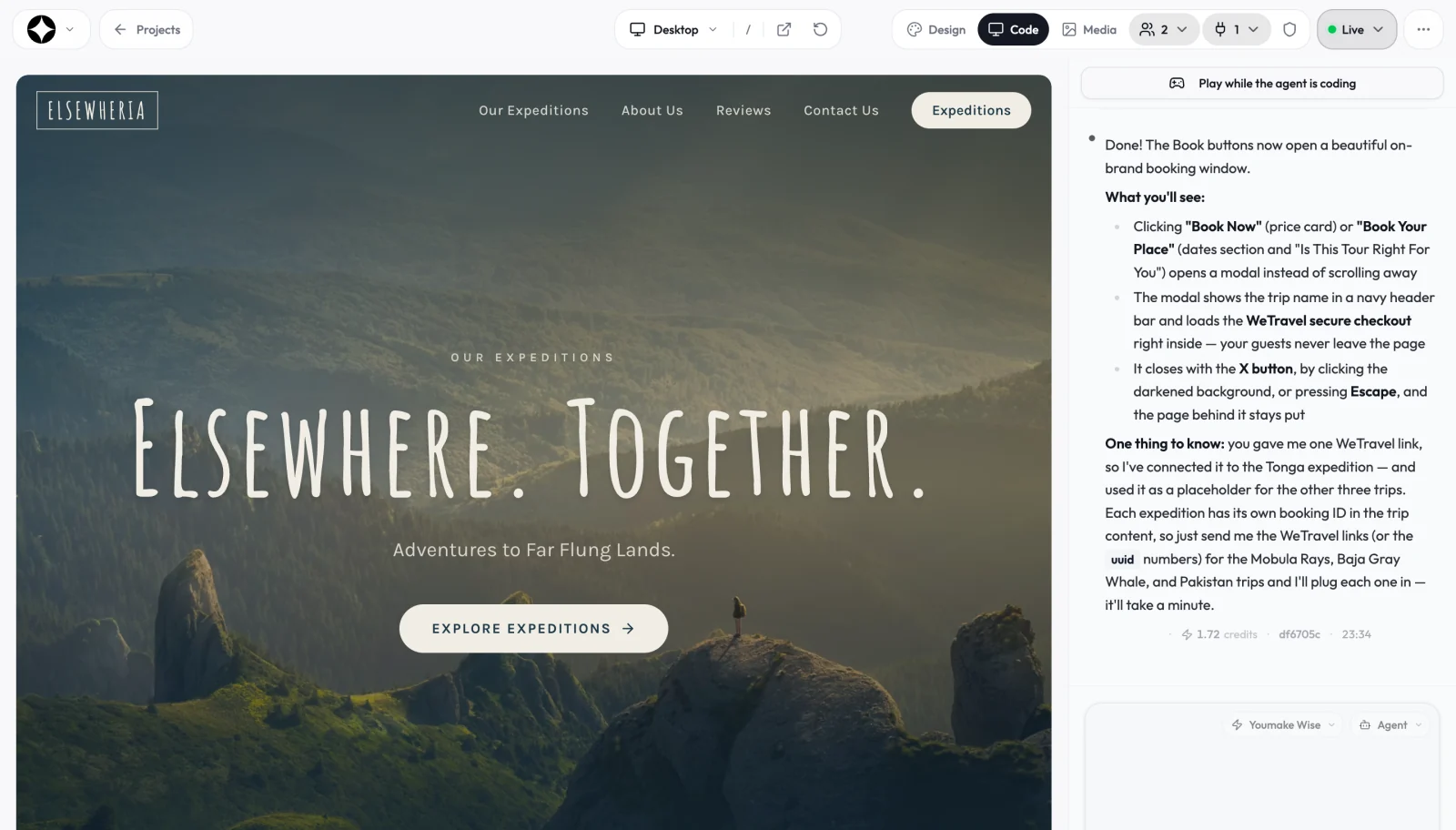
The AI website builder page shows the same flow for brochure sites, and the client portal use case covers logins and shared files.
Start a 3-day Youmake trial for $1 →
How should you price AI-built projects?
Price the outcome, not the hours the tool saved you. If you charge by the hour, a faster tool cuts your own income. A simple structure that many small studios use:
- Fixed build fee per project, scoped in the brief.
- Monthly care fee for updates, monitoring and small changes.
- Change requests quoted separately once the brief is delivered.
Your tool cost is small next to client fees, but it is real, so count it. Youmake has no free plan. There is a 3-day trial for $1 (card required), then Starter at $20 per month (40 credits, or $16 per month billed yearly), Builder at $45 (90 credits) and Agency at $120. Team seats start at Builder. Check the Youmake site for current plan details before you set your own prices. Credits are used per change, so a tight brief is cheaper than five rounds of vague prompting.
The hand-off: protect the client and yourself
Lock-in is the question that separates a professional agency from a risky one. Before you start, agree in writing on:
- Who registers the domain and holds the registrar login (the client).
- Where the code lives and who can edit it. Youmake supports code export and GitHub sync, described on the code ownership page.
- What you maintain after launch and what a change request costs.
- Who is responsible for privacy policy, cookie notice and accessibility for the client's region.
Our guide to AI app builders that let you export your code explains what to check in any tool. For the branding side of the work, read white label AI website builder for agencies.
Finding your first clients
You do not need a big portfolio. Build three small projects first: a local business site, a booking tool and a client portal. Use the ideas in vibe coding project ideas if you need prompts to start from. Then show each as a live site with a short note on what problem it solved. Pitch businesses whose current site has an obvious gap, such as no mobile layout or no way to book online. For the wider picture of how AI is changing small-business services, see our AI Industry & Business hub.
Honest limits
- AI drafts need review. Read every page. Addresses, hours, prices and claims come from the client, not the model.
- Complex work needs a developer. Custom integrations, heavy e-commerce and regulated data deserve a test plan and sometimes an engineer.
- The tool is not the moat. Anyone can open a builder. Your edge is scoping, taste, follow-through and trust.
- Terms change. Pricing, plan limits and features move, so re-check them before quoting a client.
FAQ
What is a Lovable agency? A studio that builds client sites and apps using Lovable or a similar AI app builder. The same business model works with other tools, so choose one based on domain, code export and hand-off, not the name.
Can I start an AI app agency without coding? Yes for bounded projects such as brochure sites, forms and simple web apps. Learn the basics of what a deployed app needs (domain, database, security) and bring in a developer for anything beyond that. Our what is vibe coding guide is a good primer.
Do clients own what an AI builder creates? It depends on the tool and your contract. Prefer a builder with code export or GitHub sync, put the domain in the client's name, and write the ownership terms down before you start.
Start a 3-day Youmake trial for $1 →