


On November 20, 2026, Appian published a survey of 851 senior technology decision-makers at large enterprises. It found that 82% already put at least 10% of their technology innovation budget into testing, maintaining and repairing software built with AI tools outside an approved platform. Appian calls that software "aloneware". Most builders know the problem as vibe coding technical debt: the app took an afternoon to build, and nobody planned for the two years after launch.
The companies in the survey have IT departments. If you are a founder or a small business with one AI-built app and no engineer, the same bill arrives with fewer people to pay it. This guide covers what the survey found, which parts to discount, and an upkeep plan you can set up in Youmake this week.
What the aloneware survey found
Appian defines aloneware as "applications built or modified with AI-assisted development tools outside an approved enterprise platform environment." Censuswide ran the fieldwork from October 21 to 30, 2026. The respondents were senior decision-makers, mostly in AI, engineering or IT, at companies with 5,000 or more employees or more than $1 billion in annual revenue. They came from eight countries: the USA, the UK, Australia, New Zealand, France, Germany, Italy and Spain.
| Finding | Share of leaders |
|---|---|
| Spend at least 10% of the innovation budget on testing, deploying, maintaining or repairing software built outside a platform | 82% |
| Spend at least 20% of that budget on it today | 43% |
| Expect to spend at least 20% within two years | 64% |
| Say standalone AI tools speed up development but add time for testing, integration, troubleshooting, scaling or deployment | 71% |
| Report unexpected post-launch costs for security, governance and compliance fixes | 68% |
| Find it hard to get accountable technical support for these apps | 68% |
| Have difficulty keeping code, architecture, dependencies and integrations up to date | 66% |
| Say a shared architectural foundation would help them control total cost of ownership | 73% |
Appian's CEO, Matt Calkins, summed it up in the release: "If you vibe-code them, there will be nobody to turn to when problems occur."
How much weight should you give these numbers?
Some, with one caveat. Appian sells an enterprise platform, it commissioned the research, and its definition of aloneware covers any AI-built software that sits outside a platform like the one it sells. A survey built on that definition was always likely to find trouble there. The answers are also what leaders say they spend. Nobody audited the invoices.
The direction still matches independent evidence. Last week's Vibe Code Bench results showed that the best AI model kept only 18 of 50 working apps on track through a series of updates. Building version one is the cheap part, and the survey says the same thing from the budget side.
Why vibe coding technical debt hits small teams harder
Each finding in the table has a small-team version, and it is usually worse.
Support comes first. About two thirds of enterprise leaders struggle to find someone accountable for an app built outside a platform. For a solo founder, the accountable person is you. If the app was written by an AI in a chat you no longer have, and the code sits on a laptop, you will be debugging without notes on a Sunday night.
Then the costs nobody budgeted. Security and compliance fixes after launch surprised 68% of respondents. For a small app, think of an exposed API key or a database table anyone can read. Our write-up of the Railway breach and its stolen AI API keys shows how expensive one leaked secret gets.
Dependencies age whether you touch the app or not. Payment libraries, login providers and frameworks all ship updates, and an app that worked in November can fail in March without a single change on your side.
Duplication is the last one. When building is nearly free, you end up with three apps that each have their own user table and their own login. In the survey, 73% of leaders say a shared architectural foundation would help them control cost.
What to do now: a 6-step upkeep plan
You can do all six in an afternoon, with any tool.
- Name one owner for every app. Write down who gets the alert when it breaks and who decides when to shut it off. In a team of one, write it down anyway, along with who covers when you are away.
- Keep the code in a repository you control. A GitHub repository with history gives the next person, or the next AI tool, something to read. An app that exists only inside one vendor's editor is aloneware by any definition. If your tool cannot hand you the code, read our guide to AI app builders that let you export your code.
- Write a one-page app record. What the app does, where the data lives, which outside services it calls, where the keys are stored, and how to publish a new version. One page is enough if it is accurate.
- Share a foundation across apps. Use one database project, one login system and one payment account for everything you build. Your second app should be able to see the customers from the first.
- Put upkeep on the calendar. Block an hour a month per live app: update dependencies, click through your core flows, run a security check and read the error log. Borrowing the survey's floor as a rule of thumb, keep one hour or credit in ten for upkeep before you spend the rest on new features.
- Retire what nobody uses. Every live app is something to patch. Export the data, take the app offline and delete its keys.
Once the app is live, add the alerts from our guide to monitoring a vibe-coded app in production, so you hear about failures before your customers do.
Start a 3-day Youmake trial for $1 and set this plan up on your own app →
How to manage vibe coding technical debt with Youmake
Youmake is an AI app builder for websites, web apps, mobile apps and slide decks. The upkeep plan maps onto features it already has.
- Sync the project to GitHub on day one. Youmake's code ownership features let you export the code or sync it to your own repository, so the app outlives any single chat. If you already have an AI-built app somewhere else, import its GitHub repo and continue from there.
- Ask the agent to write the app record. Paste this into the chat:
Write a file called MAINTENANCE.md at the root of this project. Include:
what the app does in 3 sentences, every page and what it is for,
every database table and what it stores, every outside service the app calls
and which environment variable holds its key, and the steps to publish a new version.
Do not change any other file.
- Build on one foundation. Connect the same Supabase project and the same Stripe account to each app you build, and tell the agent to reuse the existing users table instead of creating a new one.
- Run a monthly upkeep prompt:
Maintenance pass, no new features.
List every dependency that has a newer version and say which updates are risky.
Apply only the safe updates. Then tell me which pages or flows I should re-test by hand,
and update MAINTENANCE.md if anything changed.
- Test in the live preview, run the security scan, then publish to your own domain.
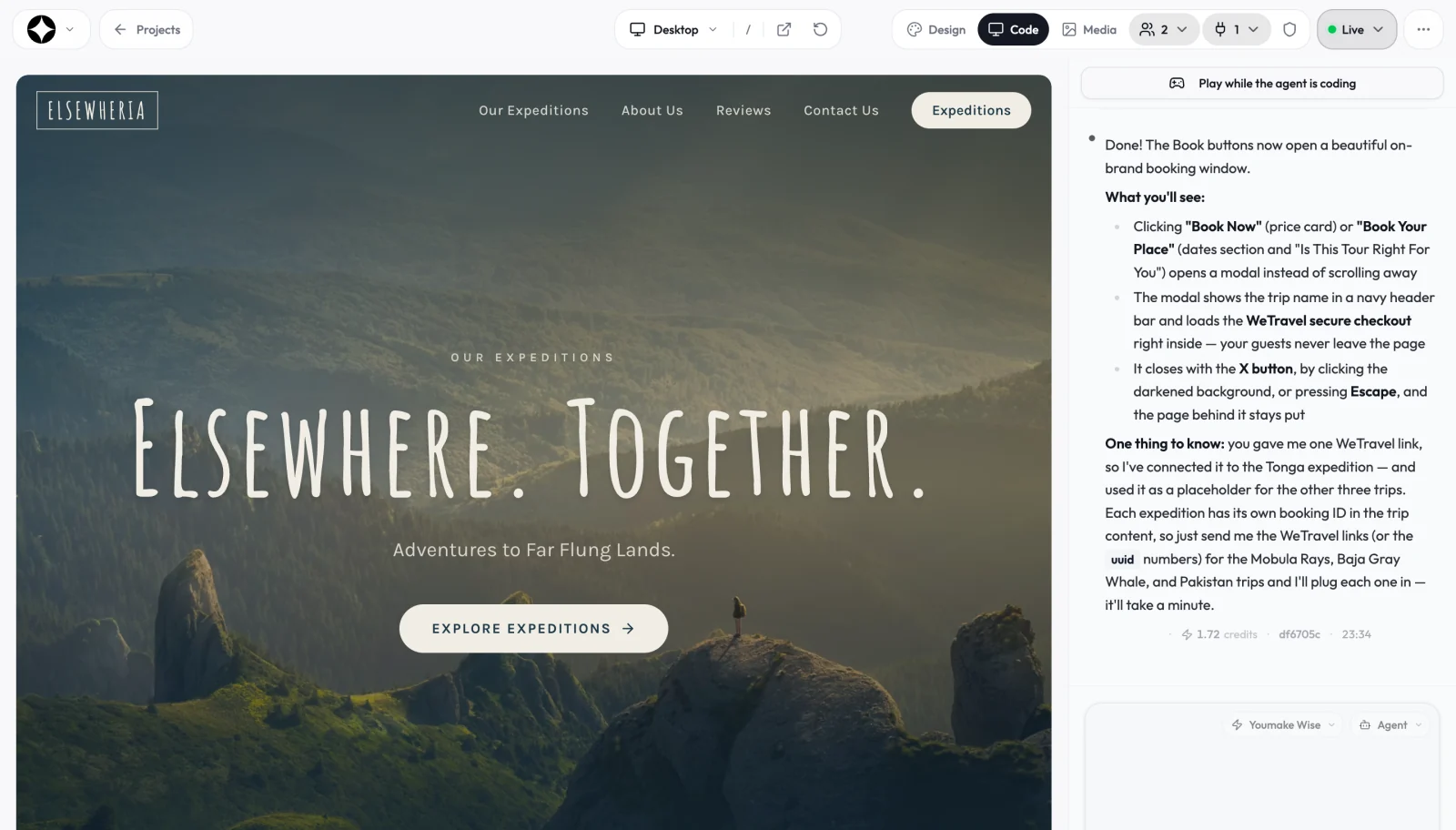
On the Builder plan and above you get team seats, so a second person can open the project when you are away. That covers the support gap in step 1. If what you run is a small-business site and not an app, the Youmake AI website builder leaves you less to maintain.
Honest limits
- The survey covers large enterprises and was paid for by a platform vendor. It shows a direction. It does not predict your costs.
- Youmake is a platform too, so weigh our advice the same way. The steps above work with any tool that gives you the code.
- Youmake does not maintain your app for you. The monthly pass uses credits and still needs you to re-test by hand.
- Youmake has no free plan. Entry is a 3-day trial for $1 (card required), then paid plans from $20 a month.
- Apps that hold health, payment or children's data need a developer or security review that no checklist replaces.
FAQ
What is aloneware? It is Appian's term for applications built or modified with AI-assisted tools outside an approved enterprise platform. In practice it describes an AI-built app with no owner, no documentation and no support path.
Does vibe coding always create technical debt? Every app creates some, however it was built. Vibe coding creates it faster because the building is quick and the understanding is thin. Owning the code, keeping a one-page record and booking a monthly upkeep hour keep the debt small enough to pay.
How much should a small team budget to maintain an AI-built app? The survey has no figure for small teams. In Appian's survey, 82% of large enterprises spend at least 10% of their innovation budget on this work and 43% spend at least 20%. Starting at one hour in ten is a reasonable floor. You will find more upkeep guides on the vibe coding hub.
Want an app you can still fix a year from now? Start a 3-day Youmake trial for $1 →
Sources
- Appian press release via PR Newswire, "Global Survey Uncovers an 'Aloneware' Crisis" (November 20, 2026): https://www.prnewswire.com/news-releases/global-survey-uncovers-an-aloneware-crisis-isolated-ai-development-threatens-enterprise-stability-and-adds-maintenance-costs-302947123.html
- Appian, The Aloneware Crisis report page: https://appian.com/resources/whitepapers/aloneware-study-what-isolated-ai-builds-cost-the-enterprise/view
- ITPro, "Vibe-coded software has caused a technical debt explosion" (November 23, 2026): https://itpro.com/software-engineering/vibe-coded-software-has-caused-a-technical-debt-explosion
- Digital Today, "Vibe coding cuts development costs but can hit corporate budgets with maintenance bills" (November 24, 2026): https://www.digitaltoday.co.kr/en/view/130135/vibe-coding-savings-maintenance-costs-hit-corporate-budgets
- Vals AI, Vibe Code Bench 1-100 v1.1 leaderboard: https://www.vals.ai/benchmarks/vcb-1-100-v1-1