

Only 18% of Gen Z employees say they want to develop or improve their AI skills, according to a Seramount survey released on November 19, 2026. That is the lowest share of any generation, below 36% of millennials, 46% of Gen X and 43% of baby boomers. The survey points to a reason: younger workers worry more that using AI will make people doubt their skills. Research backs up the worry, and it also shows the way out. When AI is clearly useful for the task and the result is visible, the penalty for using it goes away. So the best way to build Gen Z AI skills is to make something people can open and judge. With Youmake, you can describe an app or a website and have a working version live on your own domain, which gives a hiring manager something to open and judge.
What the Seramount survey found
Seramount, a talent services firm, surveyed more than 1,800 US white-collar employees at companies with at least 500 workers. The survey ran in June 2026 on NORC's AmeriSpeak panel. Seramount counts anyone 29 or younger as Gen Z.
| Measure | Gen Z | Millennials | Gen X | Boomers |
|---|---|---|---|---|
| Want to develop or improve AI skills | 18% | 36% | 46% | 43% |
| Use AI in their current role | 58% | 63% | 67% | 60% |
| Worry AI use could make others question their skills | 22% | 10% | 10% | 8% |
| Say their organization supports AI integration | 27% | 38% | 43% | not reported |
Gen Z uses AI almost as much as everyone else (58% versus 60% to 67%), so young people are using the tools; they are just less keen to be seen getting better at them. And Gen Z is more than twice as likely as millennials or Gen X to worry that AI use makes them look less capable. Fortune adds that only 27% of Gen Z respondents feel comfortable acknowledging AI use for a work task, against 47% to 53% of older colleagues, and only 30% think AI makes them more efficient.
Why young workers are right to be careful
The worry has evidence behind it. In a 2025 paper in PNAS, Jessica Reif, Richard Larrick and Jack Soll ran four preregistered experiments with 4,439 participants. People described as getting help from AI were rated lazier and less competent than people who got help from other sources. In a hiring task, managers who rarely used AI themselves favored the candidate who did not use it.
Reif, now at Wharton, told Fortune that younger workers may find AI use riskier because they have not yet built a reputation as experts. A senior engineer who uses AI gets credit for saving time, while a junior analyst doing the same thing can be read as skipping the work.
The same paper holds the useful part. In its fourth study, the penalty was fully offset when AI was described as clearly useful for the task. Managers who used AI often also did not see AI users as lazy. The judgment depends on whether the observer can see that AI helped produce something good.
So telling people you use AI can invite suspicion, while showing them what you built with it answers the question before they ask.
What to do now: turn AI use into visible proof
If you are early in your career, the goal is to make your AI skills observable. The plan below fits in one or two weekends.
- Pick a problem from your own work or field. A shift scheduler for the café where you worked, a study planner for your course, a tracker your team keeps in a spreadsheet. A real problem gives the project a story an interviewer will ask about.
- Build a working version, not a mockup. Something with a URL a stranger can open.
- Write down what you decided and what AI did. Reif's advice is to explain how AI helps you contribute more. A short "how I built this" section does exactly that: the problem, the prompts, what broke, what you fixed and what you would change.
- Put it on a page you own. A portfolio page with the live link, a screenshot and the write-up. Link it from your resume and LinkedIn.
- Repeat with a second project in a different format. One web app and one mobile app, or one tool and one landing page. A second project shows the first one was not a fluke.
You do not need to be a developer for any of this. If you can describe the problem clearly, you can build the first version. Start a 3-day Youmake trial for $1 and ship your first project this weekend →
How to build an AI portfolio project with Youmake
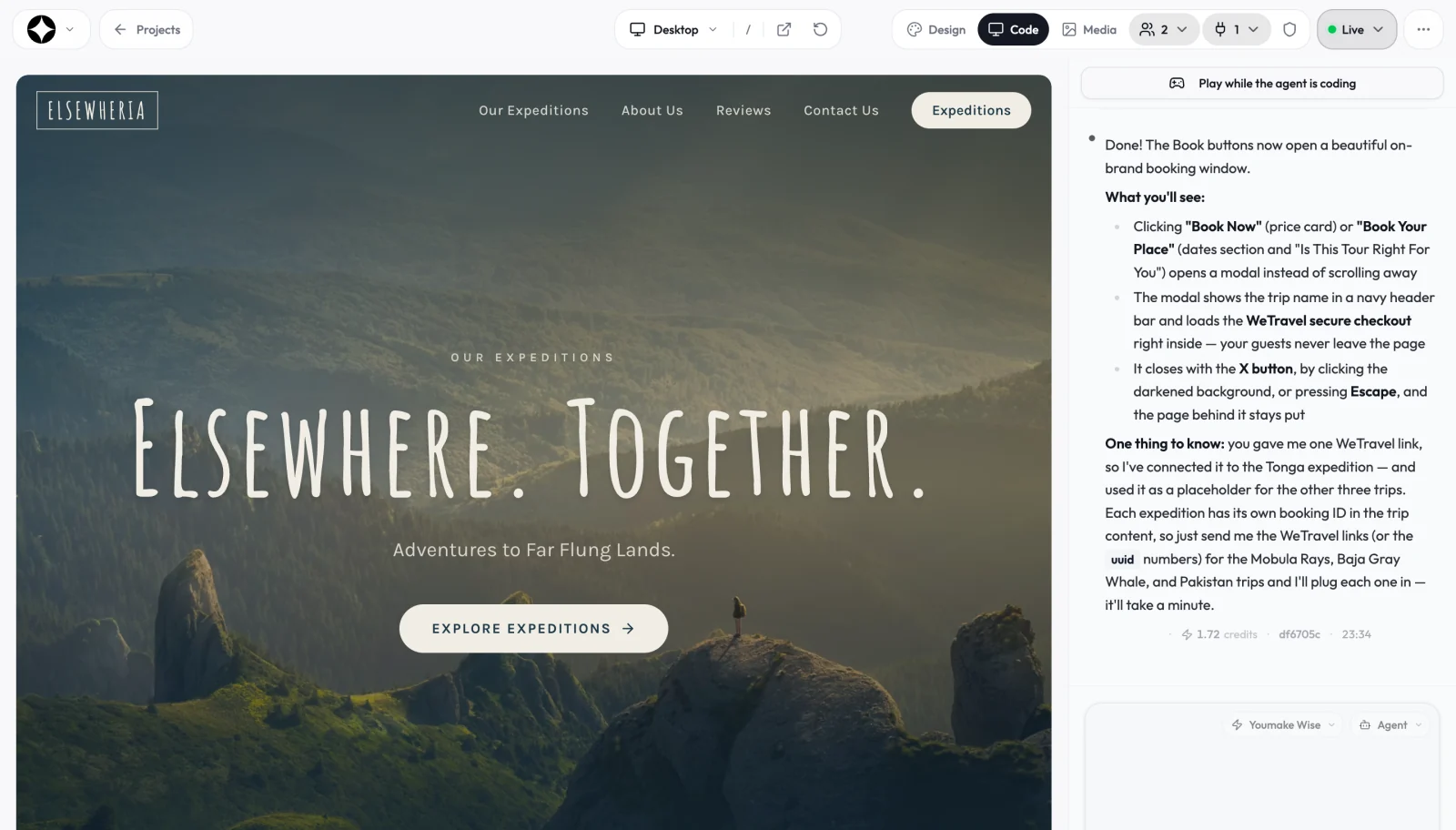
Youmake is an AI app builder: you describe what you want, watch a live preview, and refine it in a chat with the agent. It builds websites, web apps, mobile apps and slide decks in one workspace, and you can publish to your own domain or export the code to GitHub.
-
Describe the project in the composer. Here is a prompt you can paste and adapt:
Build a web app for a small café to plan weekly staff shifts. The manager adds staff with their available days, creates shifts for each day, and assigns people. Show a weekly calendar view, warn when someone is scheduled outside their availability, and let staff see only their own shifts. Clean, simple design that works on a phone.
-
Test it like a user. Click every button in the live preview. When something is off, say so in the chat in plain words ("the warning shows even when the person is available on Tuesday"). Keep a list of what you changed; that list becomes your write-up.
-
Add real data and accounts if the project needs them. Youmake connects to Supabase for a database and Stripe for payments, so a project can go past a static demo.
-
Run the security scan and publish. Youmake checks the app before publishing. Put it on your own domain so the link looks like yours.
-
Export the code to GitHub. For roles where code matters, a repository next to the live app shows you can hand off work. See how code ownership works.
-
Build your portfolio page in the same workspace. Start from the portfolio website template, add each project with its live link and your "how I built this" notes.
If you want ideas for what to build, the AI freelance projects breakdown shows which bundles clients pay more for, and how to build an app without coding walks through a first build from scratch. To understand the approach behind all of this, read what is vibe coding.
What this means for managers and founders
If you hire or manage young people, the Seramount numbers point to a support gap: only 27% of Gen Z say their organization helps them bring AI into their work. Give junior staff permission and a small, real project. Ask them to show the result and explain their process. That removes the guesswork about whether AI use is "allowed" and it gives you a fair way to judge the work. People leaving big companies face a similar choice, covered in our piece on the Microsoft voluntary exit offer: the people who do best have something live to point to.
Honest limits
- The Seramount survey covers US white-collar workers at large companies, fielded in June 2026. It says nothing about freelancers, students or small businesses, and attitudes can move fast.
- The PNAS experiments used described scenarios, not real workplaces over time. The authors themselves suggest the penalty may fade as AI use becomes normal.
- A portfolio project is not a credential. It helps you get the conversation; you still have to explain your choices in the interview.
- Youmake gives you a working first version quickly, but you still need to test it, fix what breaks and decide what the product should do.
FAQ
Do Gen Z workers use AI less than older workers? Slightly. In the Seramount survey, 58% of Gen Z use AI in their current role, compared with 60% of boomers, 63% of millennials and 67% of Gen X. The bigger gap is in wanting to build AI skills: 18% for Gen Z versus 36% to 46% for older groups.
Should I tell my manager I use AI? The PNAS research suggests the way you say it matters. Saying "I used AI" alone can hurt. Showing the finished result and explaining how AI helped you do more or better work offsets the penalty when the AI is clearly useful for the task.
What is a good first AI portfolio project? A small, working tool that solves a problem from a job or course you know: a scheduler, a tracker, a booking form or a quiz app. It should have a live link and a short write-up of what you built and why. Browse more options in the Work, Careers and Mindset hub or compare tools in our guide to the best AI app builders.
You already use AI. The next step is a project people can open. Start a 3-day Youmake trial for $1 →
Sources
- Fortune, "Only 18% of Gen Z workers want to build AI skills. A Wharton professor says using AI is riskier for them," November 21, 2026: https://fortune.com/2026/11/21/gen-z-workers-ai-skills-seramount-survey/
- Seramount press release via GlobeNewswire, "Seramount Finds Gen Z Employees Are Least Likely to Use AI at Work," November 19, 2026: https://www.globenewswire.com/news-release/2026/11/19/3406523/0/en/seramount-finds-gen-z-employees-are-least-likely-to-use-ai-at-work.html
- Reif, Larrick and Soll, "Evidence of a social evaluation penalty for using AI," PNAS 122(19), May 2025: https://pmc.ncbi.nlm.nih.gov/articles/PMC12088386/