

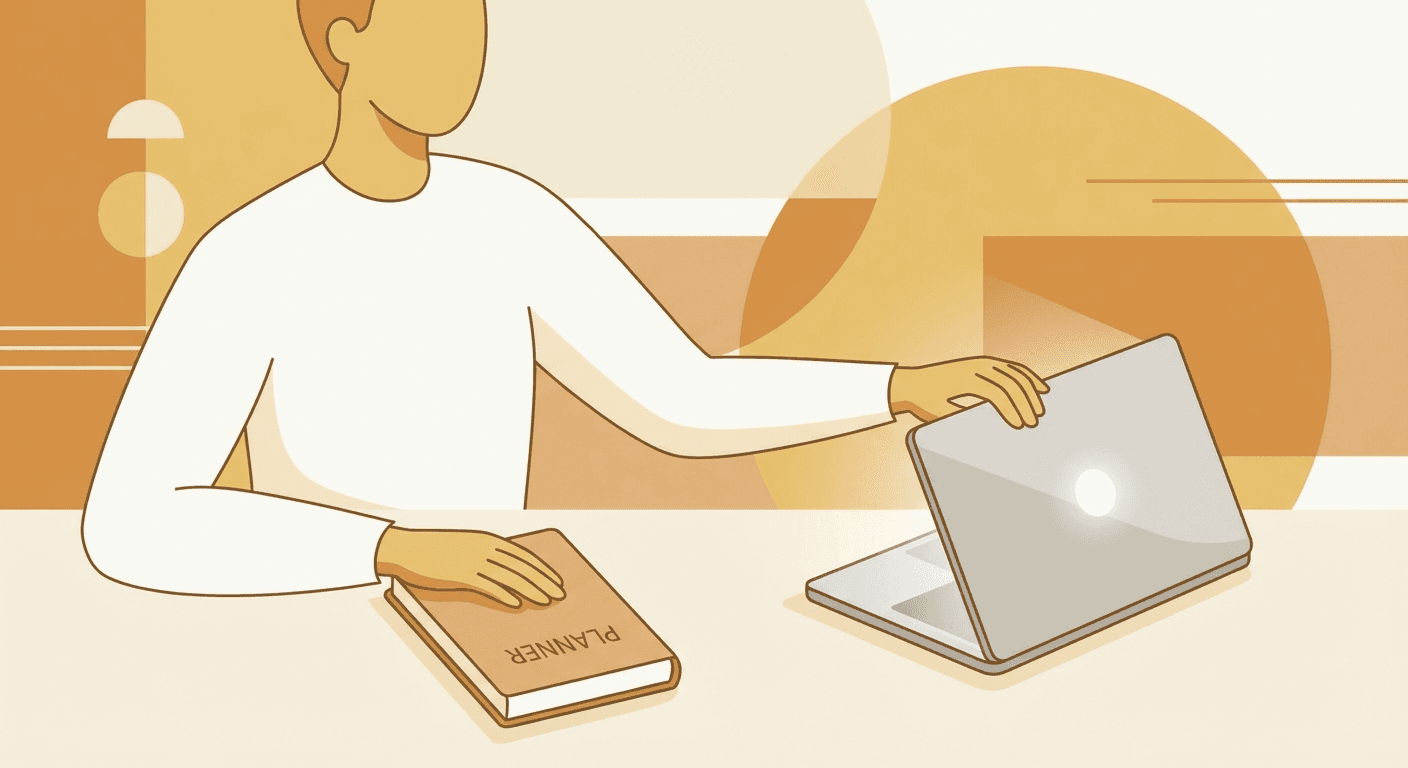
There's a particular breed of procrastination that disguises itself so well that most people never catch it. It wears a blazer. It carries a Notion template. It looks, to everyone around you, like work.
It's called planning.
The Planning Trap
Oliver Burkeman — author of Four Thousand Weeks and one of the sharpest thinkers on time management alive — recently put it bluntly on BBC Maestro: planning can be a form of procrastination. Not sometimes. Often.
His argument isn't that you should never plan. It's that compulsive planning — the kind where you spend three hours building a color-coded Gantt chart for a project you could have started in twenty minutes — is your brain's way of avoiding the discomfort of actually doing the thing.
I've seen this pattern destroy more startups than bad ideas ever will.
Why We Do It
Planning feels productive because it activates the same reward circuits as real progress. You get a little dopamine hit every time you organize a Trello board or sketch out a quarterly roadmap. Your brain genuinely can't tell the difference between planning to build and building.
But the market can. Your customers can. Your bank account definitely can.
There's a deeper psychological reason too: planning gives you the illusion of control over an inherently uncertain future. When you're staring down a product launch, a career change, or a difficult conversation, the uncertainty is physically uncomfortable. Planning numbs that discomfort without resolving it.
Burkeman calls this "holding plans loosely as a navigational aid" — and I think that framing changes everything.
The One-Person Company Test
Here's a real example of what happens when you stop over-planning. Harvard Business Review recently published a case study on Base44, a vibe coding platform launched in early 2025 by a single founder, Maor Shlomo. Working entirely alone, Shlomo built and shipped a product that leveraged generative AI to help non-technical people build software.
No co-founder retreats. No six-month product strategy decks. No advisory board meetings about market positioning. One person, shipping.
Now, I'm not saying Base44 had zero planning. But there's a world of difference between a solo founder who plans just enough to maintain direction and a ten-person team that spends Q1 debating the roadmap for Q3.
The lesson isn't "don't plan." It's: the ratio of planning to doing should never exceed 1:5. For every hour you spend planning, you should have at least five hours of execution to show for it.
The Inbox Zero Illusion
Burkeman makes another point that connects here: inbox zero is a strategy that breeds distraction. The idea that you can clear every email, respond to every Slack message, and process every input before you start "real work" is a fantasy. There will always be more inputs than you can process.
His recommendation? Strategic neglect.
This is heresy in corporate culture. We're trained to believe that being responsive equals being professional. But the most productive people I know are selectively unresponsive. They've made a conscious decision about what deserves their attention and what doesn't — and they're at peace with the fact that some things will fall through the cracks.
This is a mindset shift, not a productivity hack. It requires accepting that you are a finite being with finite time, and that saying yes to one thing always means saying no to something else.
Steven Bartlett's Three M Framework
On the same BBC Maestro platform, Steven Bartlett — the Diary of a CEO founder who built Social Chain into a $200M company by age 27 — shares what he calls the "Three M" framework for sustainable productivity:
- Meaning — Does this task connect to something you actually care about?
- Momentum — Will completing this create forward motion, or is it busywork?
- Mastery — Are you getting better at something that matters?
If a task doesn't hit at least two of the three Ms, it's probably planning disguised as progress.
I love this framework because it cuts through the noise. Most of what fills our calendars and to-do lists fails the three M test spectacularly. We do it because it feels productive, because someone asked us to, or because we've always done it.
What To Do Instead
Here's my practical take on breaking the planning addiction:
1. Start Before You're Ready
The single most powerful productivity move is starting before you feel prepared. Your first draft will be bad. Your first prototype will break. Your first sales call will be awkward. That's the point. You learn more from one hour of doing than from ten hours of planning to do.
2. Set a Planning Budget
Literally time-box your planning. If you have a project that'll take two weeks, give yourself two hours — maximum — to plan it. Then start. You can adjust the plan as you go, and you'll make better adjustments because you'll have real data from real execution.
3. Use the Two-Minute Rule (But Not How You Think)
The classic two-minute rule says: if a task takes less than two minutes, do it now. I'd modify it: if your planning for a task exceeds the time it would take to just do the task, stop planning and do the task.
4. Embrace Strategic Neglect
Pick three things that matter most this week. Do those. Let everything else either sort itself out or wait. You'll be shocked how many "urgent" items simply evaporate when you ignore them.
5. Build a Bias Toward Shipping
In software, we call this "default to ship." When in doubt, ship it. Release the blog post. Send the email. Launch the feature. The feedback from reality is infinitely more valuable than the feedback from your imagination.
The Uncomfortable Truth
The real reason we over-plan isn't strategic. It's emotional. We plan because doing is scary. Doing means we might fail, and failure is painful. Planning lets us live in a world where the project is always "going well" because it hasn't actually encountered reality yet.
Burkeman puts it beautifully: our struggles with time come from "denial of its finitude." We plan as though we have unlimited time to get everything right. We don't. None of us do.
The most successful builders I've watched — from solo AI founders to Fortune 500 executives — share one trait: they're comfortable with imperfect action. They'd rather ship something 70% right today than plan something 100% right that never launches.
Your Move
Next time you catch yourself opening a planning tool instead of opening the work itself, pause. Ask yourself: Am I navigating, or am I hiding?
If the honest answer is hiding, close the planner. Open the editor. Start typing.