

There's a pattern I keep seeing in companies trying to "do AI," and it's painful to watch.
The CEO reads an article about productivity gains. A task force is assembled. A vendor is selected. A company-wide memo goes out: "We are now an AI-first organization." Training sessions are scheduled. Dashboards are created to track adoption rates.
Six months later, adoption is at 15%. The task force writes a report blaming "change resistance." Another vendor is brought in. The cycle repeats.
Sound familiar?
A fascinating case study published in Harvard Business Review this month tells a very different story — and it holds a lesson that goes far beyond AI.
How BBVA Broke the Pattern
BBVA, one of Europe's largest banks with over 120,000 employees, faced the same challenge every large organization faces in 2026: how do you get tens of thousands of people to actually use AI tools in their daily work?
Their answer was counterintuitive: they stopped trying to mandate it.
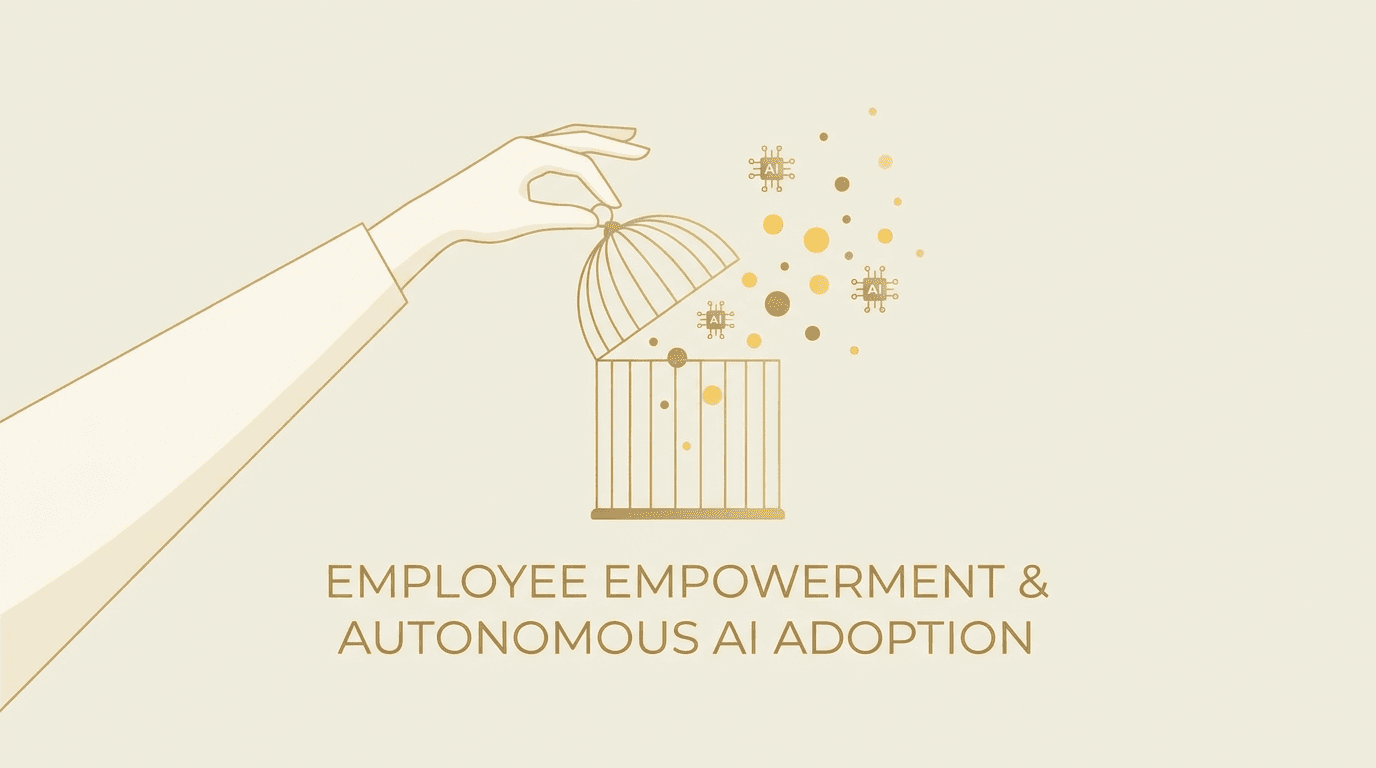
Instead of rolling out a single approved AI platform with mandatory training, BBVA did something radical for a bank. They followed their employees' lead. They looked at what people were already doing with AI — the shadow usage, the unofficial experiments, the tools people had found on their own — and built infrastructure around that organic adoption.
The results were striking. By meeting people where they already were, rather than forcing them where management wanted them to be, BBVA achieved adoption rates that most enterprise AI rollouts can only dream of.
This isn't just an AI story. It's a mindset story.
The Control Fallacy
There's a deeply embedded belief in corporate culture that change must be directed from the top. Leaders set the vision. Managers enforce compliance. Employees execute.
This model works for things like regulatory compliance, safety protocols, and financial reporting. But it fails catastrophically for tools that require creative adoption — tools where the value only emerges when people figure out their own use cases.
AI is the ultimate creative adoption tool. The person who knows that their weekly reporting process could be automated isn't the CTO — it's the analyst who spends four hours every Monday copying data between spreadsheets. The person who knows that customer complaints could be triaged by an AI agent isn't the VP of Customer Success — it's the support rep who reads 200 tickets a day.
The people closest to the work are the people best positioned to see where AI fits.
When you mandate AI adoption from the top, you're essentially saying: "We know better than you how you should do your job." That's not just inefficient — it's insulting.
The Trust Paradox
Here's the uncomfortable truth that most leadership teams don't want to hear: if your employees aren't adopting AI, the problem is probably you, not them.
Low AI adoption in organizations almost always traces back to one of three trust failures:
1. You Don't Trust Employees to Experiment
Many companies restrict AI tool access behind approval processes, IT reviews, and vendor assessments. These controls exist for real reasons — data security, compliance, cost management. But when the approval process takes three months and the employee needs an answer today, they'll either use a personal account (shadow AI) or just not bother.
The question isn't whether to have controls. It's whether your controls are designed to enable experimentation or prevent it.
2. Employees Don't Trust That AI Won't Replace Them
This is the elephant in every room. Study after study in 2025 and 2026 shows that the primary barrier to AI adoption isn't technical skill — it's fear. When you announce an "AI transformation initiative," many employees hear "we're figuring out who to lay off."
BBVA's approach sidesteps this because it positions AI as the employee's tool, not management's tool. When the initiative comes from the bottom up, the narrative changes from "AI is coming for my job" to "I found something that makes my job easier."
3. There's No Psychological Safety to Fail
AI tools hallucinate. They get things wrong. They produce confidently incorrect outputs. If an employee uses an AI tool, acts on its output, and something goes wrong — what happens? In most organizations, they get blamed.
That kills experimentation instantly. Why would anyone try a new tool if the downside is career risk and the upside is... slightly faster spreadsheets?
Organizations that succeed at AI adoption create explicit permission to experiment and fail. They celebrate the employee who tried ChatGPT for customer analysis and got weird results, because that person is learning the tool's boundaries — which is exactly what everyone needs to do.
What the Musk-Altman Trial Teaches About Control
If you want a case study in what happens when control and trust collide, look no further than the Elon Musk vs. OpenAI trial happening right now.
Musk's core argument is about control: he funded OpenAI as a nonprofit, he expected it to remain a nonprofit, and when it pivoted to a for-profit structure, he felt betrayed. His testimony this week was filled with language about ownership, equity splits, and who had the right to determine OpenAI's direction.
Altman's counter-narrative — which has played out over years, not just in the courtroom — is about adaptation. The world changed. AI needed more capital than a nonprofit could raise. The mission evolved. Holding rigidly to the 2015 plan would have meant falling behind Google, Meta, and Anthropic.
Neither side is entirely wrong. But the dynamic is instructive: the person who tries to maintain control often loses it entirely, while the person who adapts to emerging reality — even messily — ends up shaping the future.
This exact dynamic plays out in every organization trying to adopt AI. The leaders who grip tightly — mandating specific tools, requiring approval for every use case, measuring adoption by logins instead of outcomes — end up with rebellious shadow usage and low official numbers. The leaders who create conditions for organic adoption and then build infrastructure around what emerges end up with genuine transformation.
A Practical Framework for Leaders
If you're responsible for AI adoption in your organization, here's what I'd actually do:
Step 1: Audit the Shadows
Before you mandate anything, find out what your people are already doing. Survey them anonymously. Ask: "Are you using any AI tools for work? Which ones? For what?" You'll be shocked at the results. Most organizations have 3-5x more AI usage than they think — it's just happening outside official channels.
Step 2: Legitimize, Don't Legislate
Take what you find in the shadow audit and make it official. If 40 people are using ChatGPT for email drafting, don't ban it — give them a secure enterprise account. If someone in finance built a GPT that automates reconciliation, don't shut it down — help them make it robust.
Step 3: Build Champions, Not Compliance
Identify the organic power users and make them internal advocates. Not with a formal title or extra meetings — just give them permission and a small budget to share what they've learned. Peer-to-peer adoption is 10x more effective than top-down training.
Step 4: Measure Outcomes, Not Logins
Stop tracking "AI adoption rate" as a metric. Start tracking "time saved," "quality improved," or "problems solved." Nobody cares if 80% of your employees logged into the AI tool. You should care if 20% of them are using it to do genuinely better work.
Step 5: Protect the Experimenters
Explicitly create a safe space for AI experimentation. If someone uses an AI tool and the output is wrong, that's a learning moment — not a performance issue. Make this policy visible and repeat it often. Trust is built through consistent behavior, not one-time announcements.
The Mindset Shift
The deeper lesson here isn't about AI at all. It's about the difference between two leadership mindsets:
Control mindset: "I need to direct my people toward the right tools and the right outcomes."
Trust mindset: "My people are smart enough to find the right tools. I need to create conditions where their discoveries can scale."
The control mindset made sense when tools were expensive, scarce, and required deep technical expertise. You needed central IT to evaluate, procure, and deploy enterprise software.
AI tools in 2026 are none of those things. They're cheap, abundant, and accessible to anyone who can type a sentence. The bottleneck isn't tool access — it's imagination. And imagination doesn't respond to mandates.
The organizations that will win the AI era aren't the ones with the biggest budgets or the most aggressive transformation roadmaps. They're the ones with leaders who are secure enough to say: "I don't know how AI should change your job. But I trust you to figure it out."
That's not just good AI strategy. That's good leadership.