

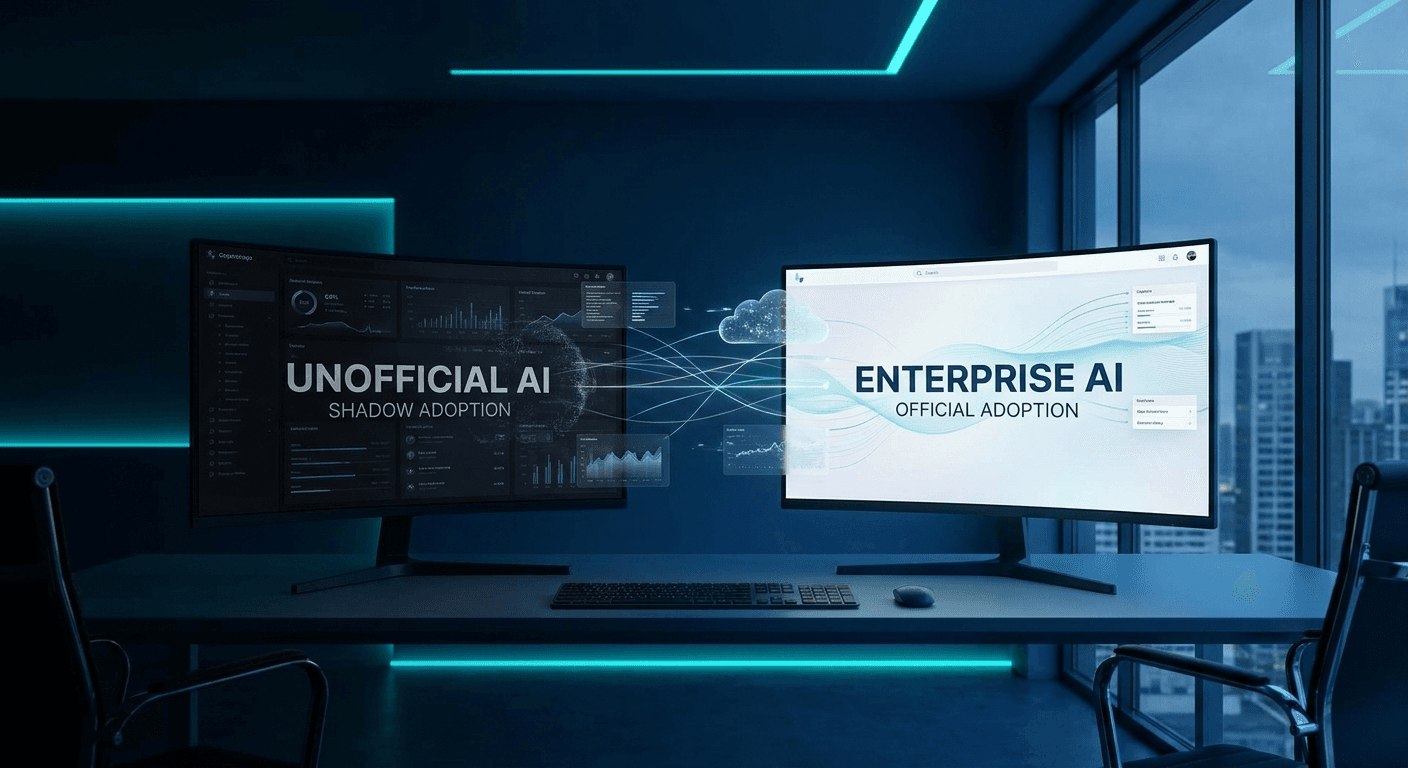
There's a quiet mutiny happening inside every large corporation right now, and most executives are pretending not to see it.
While leadership teams spend months debating AI governance frameworks and procurement cycles, their employees have already moved on. They're using ChatGPT on personal laptops. They're feeding sensitive documents into Claude during lunch breaks. They're building entire workflows on AI tools their IT department doesn't even know exist.
This isn't some fringe behavior. It's the new normal. And the companies that refuse to acknowledge it are setting themselves up for a crisis that makes data breaches look quaint.
The Numbers Don't Lie
A recent Andreessen Horowitz analysis found that 29% of Fortune 500 companies and roughly 19% of the Global 2000 are now live, paying customers of leading AI startups. That's remarkable penetration for technology that effectively launched with ChatGPT in November 2022. In just over three years, nearly one-third of the world's largest companies have signed real enterprise AI contracts.
But here's the thing — that 29% only captures the official adoption. The real number is dramatically higher.
Harvard Business Review reported this month that employees across major organizations, including those at financial institutions and government agencies, are routinely using personal AI tools alongside their secured corporate devices. One official at a large central bank admitted that employees working on air-gapped, no-AI PCs keep personal laptops open to their favorite LLM right next to them.
This is shadow AI. And it's everywhere.
Why Shadow AI Exists
The answer is painfully simple: corporate AI programs are too slow, too restrictive, and often too bad.
Most enterprise AI rollouts follow a predictable pattern. A task force is formed. Vendors are evaluated. A pilot is launched. The pilot takes six months. The output is a clunky internal tool that's worse than what employees can access for $20/month on their personal devices. By the time the "official" solution launches, employees have been using consumer AI for a year and have zero interest in downgrading.
The MIT statistic that 95% of generative AI pilots fail to convert has been widely cited, and while a16z argues the real figure is much lower, the perception alone is damaging. Employees see pilot after pilot go nowhere, and they vote with their feet — or rather, with their browser tabs.
Where Enterprise AI Is Actually Working
The a16z data tells a fascinating story about where AI adoption is actually sticking in the enterprise. Three use cases dominate:
Coding is the outlier — by nearly an order of magnitude. Tools like Cursor, Claude Code, and Codex have seen explosive growth. Companies report that their best engineers have seen 10-20x productivity improvements with AI coding assistants. Code is the ideal AI use case: it's data-dense, text-based, precisely verifiable, and has tight feedback loops. Engineers also tend to be early adopters who'll just pick the best tool regardless of what IT says.
Customer support is the second major winner. Unlike coding, support work is entry-level, often outsourced, and historically under-invested in. AI excels here because support interactions are time-bound, well-defined, and follow standard operating procedures. Companies replacing offshore BPO operations with AI support agents are seeing immediate ROI.
Search and knowledge retrieval rounds out the top three. Enterprises are drowning in documents, and AI-powered search that actually understands context and intent is proving far more valuable than the keyword-based internal tools that most companies still rely on.
The industries leading adoption? Tech (naturally), legal, and healthcare. All three are knowledge-intensive sectors where the time saved by AI translates directly into revenue or cost savings.
The Real Risk Nobody's Talking About
Shadow AI isn't just a governance headache — it's a security time bomb.
When an employee pastes a confidential merger document into a personal ChatGPT account, that data potentially enters a training pipeline the company has zero control over. When a financial analyst uses Claude to model quarterly projections on a personal device, there's no audit trail, no compliance record, no way to know what went where.
The irony is thick: many companies have restricted AI access precisely because of security concerns, but that restriction is creating the security problem. Employees denied access to approved tools don't stop using AI. They just start using it in ways that are completely invisible to the organization.
CVS Health recently won gold and silver at the 2026 Stevie Awards for Enterprise AI innovation — recognition that came from actually building enterprise-scale AI solutions that employees want to use. That's the model. If your official tools are good enough, people will use them instead of the shadow alternatives.
What Smart Companies Are Doing Differently
The companies winning at enterprise AI in 2026 share a few common traits:
1. They start with adoption, not governance. Instead of spending six months on an AI policy before anyone touches the technology, they get tools into employees' hands quickly and iterate on governance in parallel. Policy that's written without understanding how people actually use AI is useless policy.
2. They match the consumer experience. If your enterprise AI tool is worse than what someone can get from Claude or ChatGPT for free, you've already lost. Companies like Adobe, which recently launched a comprehensive AI suite for corporate clients, understand that enterprise doesn't have to mean inferior.
3. They measure shadow usage. The most sophisticated organizations are actively monitoring for unauthorized AI tool usage — not to punish, but to understand. If 40% of your marketing team is using Midjourney on personal accounts, that's a signal that your creative tooling has a gap. The shadow tells you what the market wants.
4. They focus on the use cases that work. Rather than trying to boil the ocean with "AI transformation," they pick the high-impact, proven use cases — coding, support, search — and nail those first. Momentum builds from success, not strategy decks.
5. They invest in AI literacy. The gap between AI-savvy employees and everyone else is widening. Companies that run practical AI training programs (not theoretical seminars) create a workforce that can use AI responsibly and effectively.
The Builder's Opportunity
If you're a builder — a developer, a founder, someone who makes things — the shadow AI trend is a massive signal.
Every shadow tool being used represents an unmet need that the enterprise hasn't solved yet. Every employee using a personal AI account is a user waiting for a better, sanctioned alternative. The market for enterprise AI tools that are actually good enough that people prefer them over consumer alternatives is enormous and still largely unserved.
The bar isn't just "better than nothing." The bar is "better than ChatGPT." That's a high bar, but it's the only one that matters.
The companies that figure this out — that build AI tools employees genuinely want to use rather than tools they're forced to use — will own the enterprise AI market. Everyone else will keep writing governance documents while their employees build the future on personal laptops.
The shadow AI revolution isn't a problem to be solved. It's a signal to be followed.