

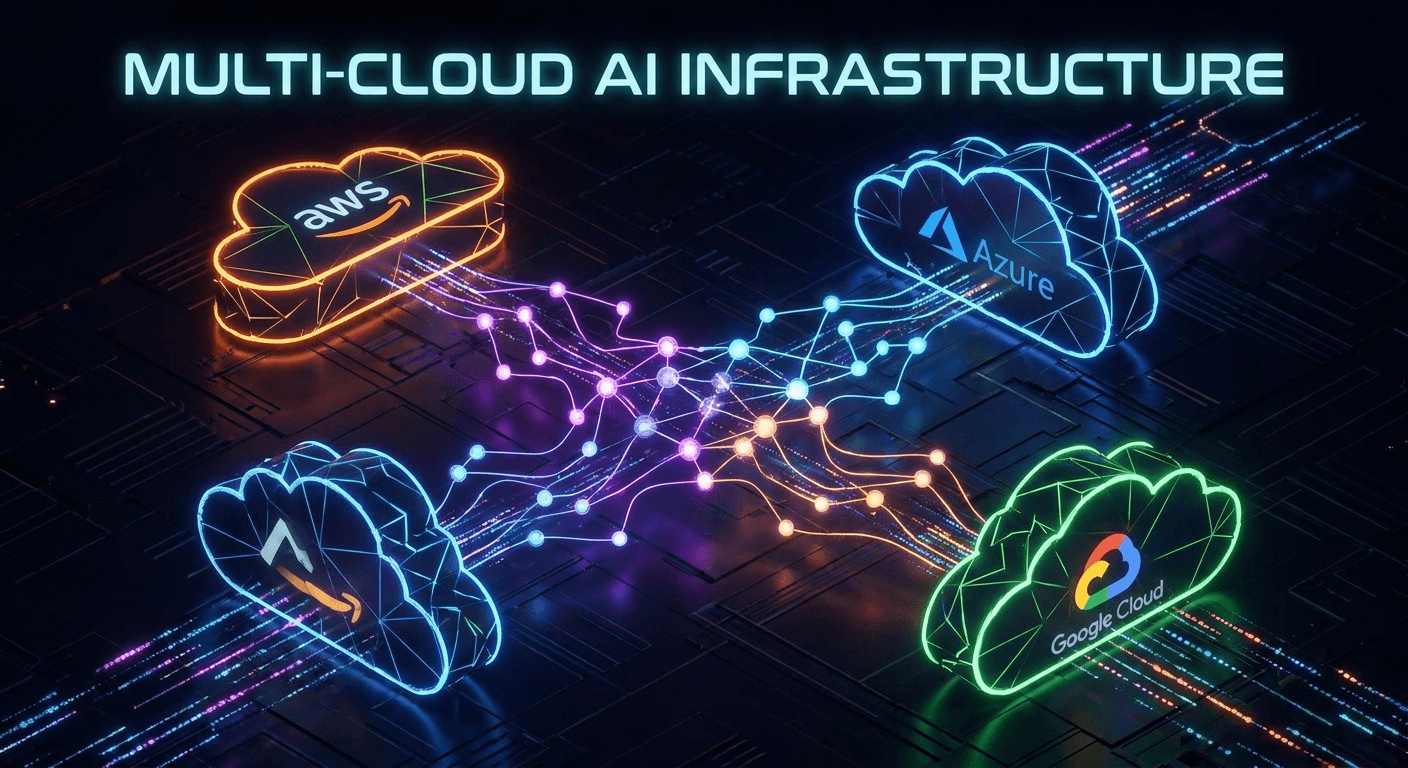
Something massive happened this week that most people scrolled past. On April 27th, Microsoft and OpenAI announced they've amended their partnership agreement. The headline: OpenAI can now serve its products on any cloud provider, not just Azure.
Two days later, we learned exactly what that means in practice: Bedrock Managed Agents, powered by OpenAI — a deep integration with Amazon Web Services that essentially brings Codex-level agent capabilities into the AWS ecosystem.
If you're building with AI, this changes everything.
The Old Deal Was Choking Both Sides
Here's the irony that nobody talks about: Microsoft's exclusive lock on OpenAI models was hurting Microsoft.
The arrangement seemed like a dream in 2023. Azure was the only hyperscaler where you could access GPT-4, GPT-4o, and the o-series models through an API. That's a hell of a competitive moat. Enterprises who wanted OpenAI had to come through Azure's door.
But here's what actually happened: enterprises didn't switch clouds. They just used Anthropic instead.
If your company had spent years building infrastructure on AWS — and roughly 31% of the global cloud market is AWS — you weren't about to migrate your entire stack just to access one model provider. You'd use Claude on Bedrock and call it a day. Anthropic's rapid growth in 2025 and early 2026 wasn't just about model quality. It was about availability where customers already lived.
The exclusivity clause was supposed to give Azure an edge. In practice, it was giving Anthropic a head start.
What the New Deal Actually Says
Let's break down the key terms, because the details matter:
- Microsoft remains OpenAI's primary cloud partner. OpenAI products still ship first on Azure, unless Microsoft can't or won't support the required capabilities.
- Microsoft's license to OpenAI IP is now non-exclusive, running through 2032.
- Microsoft stops paying revenue share to OpenAI. This is huge — Azure's PnL just got a lot cleaner.
- OpenAI continues paying revenue share to Microsoft through 2030, with a total cap.
- The AGI clause is gone. Previously, if OpenAI achieved AGI, certain terms could change. Now the agreement runs through 2032 regardless of technical milestones.
- Microsoft keeps its equity stake in OpenAI.
Read that list again. Microsoft is basically saying: "We'd rather own a piece of a much bigger pie than own all of a shrinking one."
Smart move. Maybe the smartest thing Satya Nadella has done since acquiring OpenAI's exclusive rights in the first place.
Bedrock Managed Agents: Why AWS Is the Real Story
The OpenAI-AWS integration isn't just "we'll host the models on AWS too." It's a deeply integrated agent platform.
Think about what makes OpenAI's Codex compelling: it runs locally, which solves a massive amount of security and latency complexity for free. Now imagine trying to make AI agents work across an entire enterprise — accessing databases, triggering workflows, reading documents, managing permissions. That's a completely different beast.
Bedrock Managed Agents is designed to make that enterprise-agent complexity manageable for organizations that already have their data, IAM policies, and infrastructure in AWS. It's not just model hosting. It's an opinionated framework for building production agent systems on top of OpenAI's models within the AWS ecosystem.
This is the kind of thing Anthropic had been able to offer AWS customers, and now OpenAI is competing directly on that turf.
The Musk Trial Makes This Even More Interesting
You can't talk about OpenAI this week without mentioning the trial. As Elon Musk testified in his case against Sam Altman on April 28th, he painted a picture of an organization that was supposed to be an open-source nonprofit — and became the most commercially aggressive AI company on the planet.
Musk told the court: "I came up with the idea, the name, recruited the key people, taught them everything I know, provided all the initial funding."
Whatever you think about the merits of Musk's lawsuit, the timing is poetic. On the same day Musk argued that OpenAI betrayed its founding principles, OpenAI was finalizing a deal that makes it a truly independent commercial entity — free from platform lock-in, free from AGI clauses, free from any single corporate patron.
The nonprofit that was "specifically meant to be a charity that does not benefit any individual person" is now shopping its models across every cloud on earth. The original OpenAI is dead. What replaced it is — for better or worse — the most important AI company in the world.
What This Means for Builders
If you're building AI-powered products right now, here's what I'd actually pay attention to:
1. Multi-Cloud AI Is Now the Default
The moat for any single cloud provider was always going to erode. Now it's happening faster than expected. If you're choosing between OpenAI and Anthropic, the deciding factor is no longer "which cloud are we on?" It's model quality, pricing, agent capabilities, and ecosystem tooling.
This is great for builders. Competition drives down prices and drives up quality.
2. The Agent Platform War Is the Real War
Nobody actually cares which company hosts the model weights. What matters is the platform around those models — the agent frameworks, the tool integrations, the security models, the observability layers. AWS Bedrock Managed Agents vs. Azure AI Agent Service vs. Google Vertex AI Agents — that's where the real differentiation is happening.
3. Lock-In Is Moving Up the Stack
Cloud providers learned from the database wars: you don't lock customers in at the compute layer anymore. You lock them in at the workflow layer. If you build your agent orchestration on Bedrock Managed Agents, switching to Azure later isn't trivial — even if the underlying model is the same.
Be aware of this. Abstract your agent logic where it matters.
4. OpenAI Is Becoming a Model-as-a-Service Company
Strip away the consumer products and the brand, and OpenAI is increasingly looking like ARM — licensing its core technology to every platform that will have it. That's not a bad business. ARM's market cap is over $150 billion. But it's a very different company than the one Musk thought he was co-founding in 2015.
The Bigger Picture
We're watching a fundamental realignment in real time. The first wave of AI was about model breakthroughs. The second wave was about consumer products — ChatGPT, Copilot, Gemini. The third wave, the one we're entering now, is about enterprise infrastructure.
The companies that win won't be the ones with the smartest models. They'll be the ones that make AI agents actually work inside messy, complex, real-world organizations.
OpenAI just bet big on AWS being the platform where that happens. Microsoft is betting that their equity stake will more than compensate for what they lost.
And builders like us? We're the ones who actually benefit. More models, more platforms, more competition, lower prices.