

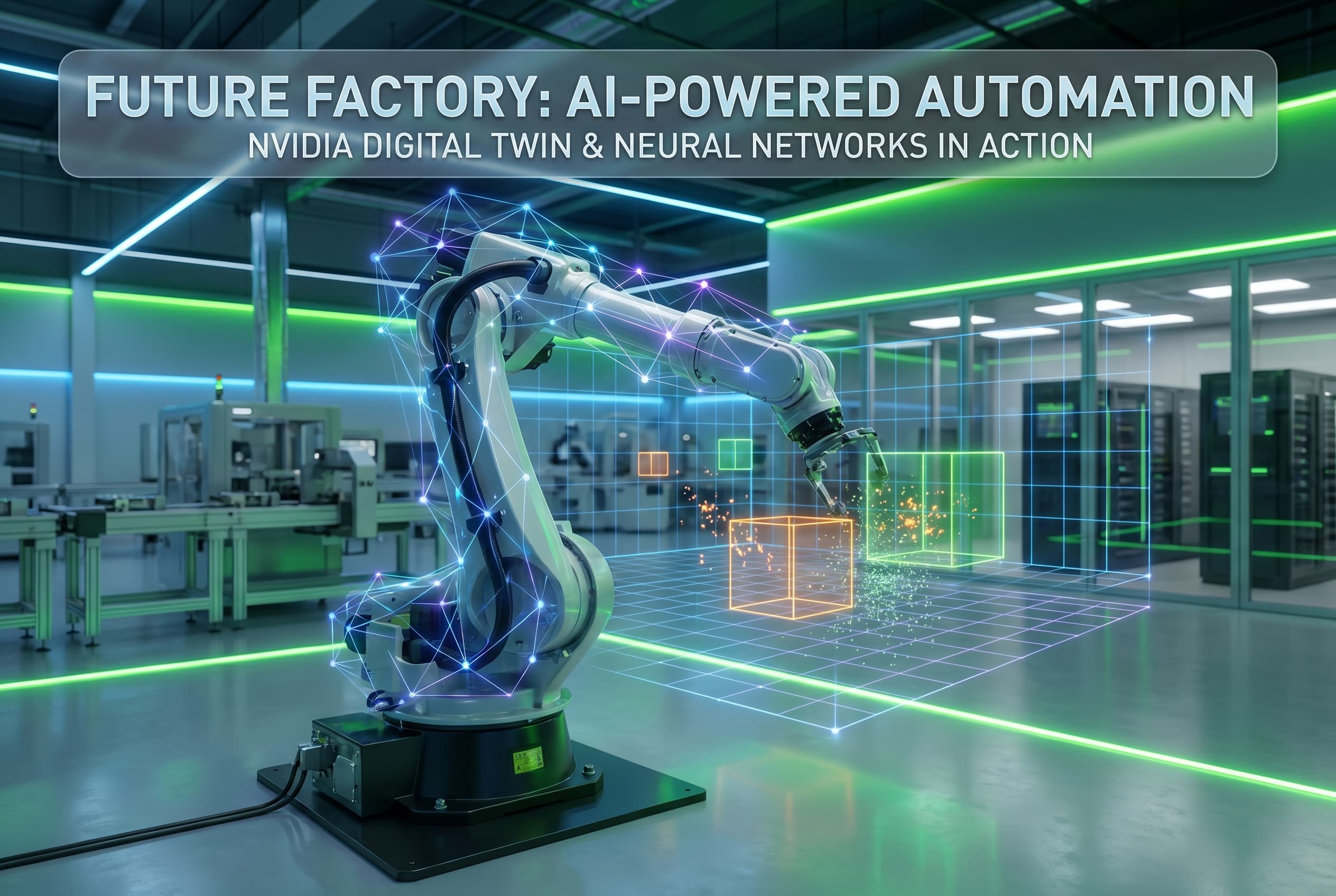
For years, AI has been brilliant at text, images, and code — but embarrassingly bad at the physical world. Ask an LLM to write a sonnet and it'll impress you. Ask a robot to pick up an oddly shaped item from a cluttered shelf and watch it fumble like a toddler.
That gap just got significantly smaller. NVIDIA's Cosmos 3, launched in early June 2026, is the first foundation model that unifies physical reasoning, world generation, and action generation in a single architecture. And they made it open source.
This is not an incremental improvement. It's a paradigm shift.
What Cosmos 3 Actually Does
Most AI models work with text or pixels. Cosmos 3 works with physics.
Built on what NVIDIA calls a "mixture-of-transformers" architecture, Cosmos 3 integrates a reasoning transformer with an expert generation transformer. The result is a model that can natively understand and generate text, images, video, ambient sound, and — crucially — actions. All with physics accuracy.
Think about what that means. Instead of a robot needing separate vision models, language models, planning models, and motor control systems stitched together with duct tape and prayer, Cosmos 3 provides a unified understanding of how the physical world works. It understands motion, causality, spatial relationships, and the consequences of actions.
The model comes in two sizes: Cosmos 3 Nano (16 billion parameters, optimized for workstations) and Cosmos 3 Super (64 billion parameters, designed for data center deployment). Both are available on Hugging Face and NVIDIA's build platform.
Why "Open" Changes Everything
Here's what separates this from typical Big Tech announcements: Cosmos 3 is genuinely open. You can download it, fine-tune it, generate synthetic training data with it, and deploy it.
This matters enormously because physical AI has been trapped in a chicken-and-egg problem. Training robots requires massive amounts of real-world data — but collecting that data means running physical robots in physical environments, which is slow, expensive, and often dangerous.
Cosmos 3 breaks this cycle. Since the model understands physics, it can generate synthetic training scenarios that are physically plausible. A robotics startup can now train their systems on millions of simulated interactions without building a single physical testbed first. That's the difference between a field accessible only to companies with billion-dollar budgets and one open to five-person teams with a rented GPU cluster.
As Axios reported, industry experts are calling this the "GPT moment" for physical AI — the point where capability crosses a threshold that makes entirely new applications practical.
The Factory Floor Is Already Moving
NVIDIA isn't just releasing a model and hoping for adoption. They've lined up the biggest names in industrial robotics.
ABB Robotics has integrated NVIDIA Omniverse into its RobotStudio software, creating "RobotStudio HyperReality" — a tool that generates physically accurate simulations with 99% fidelity to real-world conditions. ABB estimates this will reduce deployment costs by up to 40% and accelerate time-to-market by 50%, with production rollout expected in the second half of 2026.
FANUC is leveraging NVIDIA's Isaac Sim platform with its ROBOGUIDE software to create photorealistic virtual factories. Their robots can now interpret voice commands, generate Python code for new tasks, and use NVIDIA Jetson hardware for real-time collision avoidance.
LG Group and NVIDIA announced a partnership to build AI factories — massive infrastructure that combines training, simulation, and deployment for autonomous manufacturing systems. Doosan Group has a similar collaboration focused on robotics and smart factories.
This isn't vaporware. These are production partnerships with companies that collectively manufacture millions of industrial robots.
The Real Competition: Software AI vs. Physical AI
Here's the strategic picture that most people are missing.
While OpenAI pivots toward enterprise software and Apple redesigns Siri, NVIDIA is quietly building the operating system for the physical world. The new U.S. Executive Order on AI, signed June 2, 2026, establishes a voluntary framework for frontier model review — but it's clearly oriented toward software models. Physical AI exists in a policy gray zone.
DARPA and the NSF launched AI Forge, a program specifically designed to bridge commercial AI innovation with national security applications. Physical AI — robots that can see, move, and react in contested environments — is the obvious intersection.
The global AI chip market surpassed $100 billion in 2026, driven largely by data center demand. But the next wave of chip consumption won't come from cloud servers — it'll come from edge devices running models like Cosmos 3 Nano in warehouses, hospitals, construction sites, and farms.
NVIDIA isn't just selling GPUs anymore. They're selling the entire stack — from silicon to simulation to deployment — for a world where AI has a body.
What This Means for Builders
If you're building anything that interacts with the physical world, Cosmos 3 changes your calculus:
Robotics startups: The barrier to entry just collapsed. You no longer need to collect millions of hours of physical training data. Generate it synthetically, validate in simulation, deploy to hardware. The Isaac Sim framework gives you the pipeline.
Manufacturing companies: Digital twins are no longer a "nice to have." ABB's 99% sim-to-real accuracy means you can prototype, test, and validate entire production lines virtually before committing to physical buildout. We wrote about how corporate America is rethinking its digital transformation approach — this is the execution layer.
Logistics and warehousing: Amazon and others have been struggling with autonomous picking and packing. A unified model that understands spatial relationships and physics could finally crack the problem of manipulating diverse objects in unstructured environments.
Healthcare: Surgical robotics, rehabilitation systems, prosthetics — any domain where a machine needs to interact precisely with the physical world benefits from better physics understanding.
The Bigger Picture
We've been living in the era of "AI that reads and writes." Cosmos 3 signals the beginning of "AI that sees and moves."
The implications are staggering. A world where physical labor can be learned by machines the same way language was learned — from massive datasets, through foundation models, with transfer learning across domains — is a world where the economics of manufacturing, logistics, construction, and agriculture fundamentally change.
As we explored in the physical AI chatbot moment for robotics, this has been building for years. What's different now is that the model exists, it's open, and the industrial ecosystem is already building on it.
NVIDIA's Jensen Huang called this the "big bang of physical AI" at GTC 2026. For once, the hype might actually be underselling the reality.
The trillion-dollar question is: who builds the killer applications? NVIDIA built the platform. The trillion-dollar AI boom is providing the funding. The models are open. The only thing missing is you.
Sources
- NVIDIA: Cosmos 3 Launch Announcement
- NVIDIA Developer Blog: Cosmos 3 Reasoning and Action Models
- Hugging Face: Cosmos 3 for Physical AI
- Axios: AI News — NVIDIA Cosmos 3, OpenAI Sites
- ABB Robotics x NVIDIA Partnership Announcement
- FANUC: Physical AI with NVIDIA Technologies
- NVIDIA Blog: NVIDIA and LG Group AI Factory
- DARPA: AI Forge for National Security
- Fenwick: New AI Executive Order Analysis
- Automate.org: NVIDIA Big Bang of Physical AI at GTC 2026