

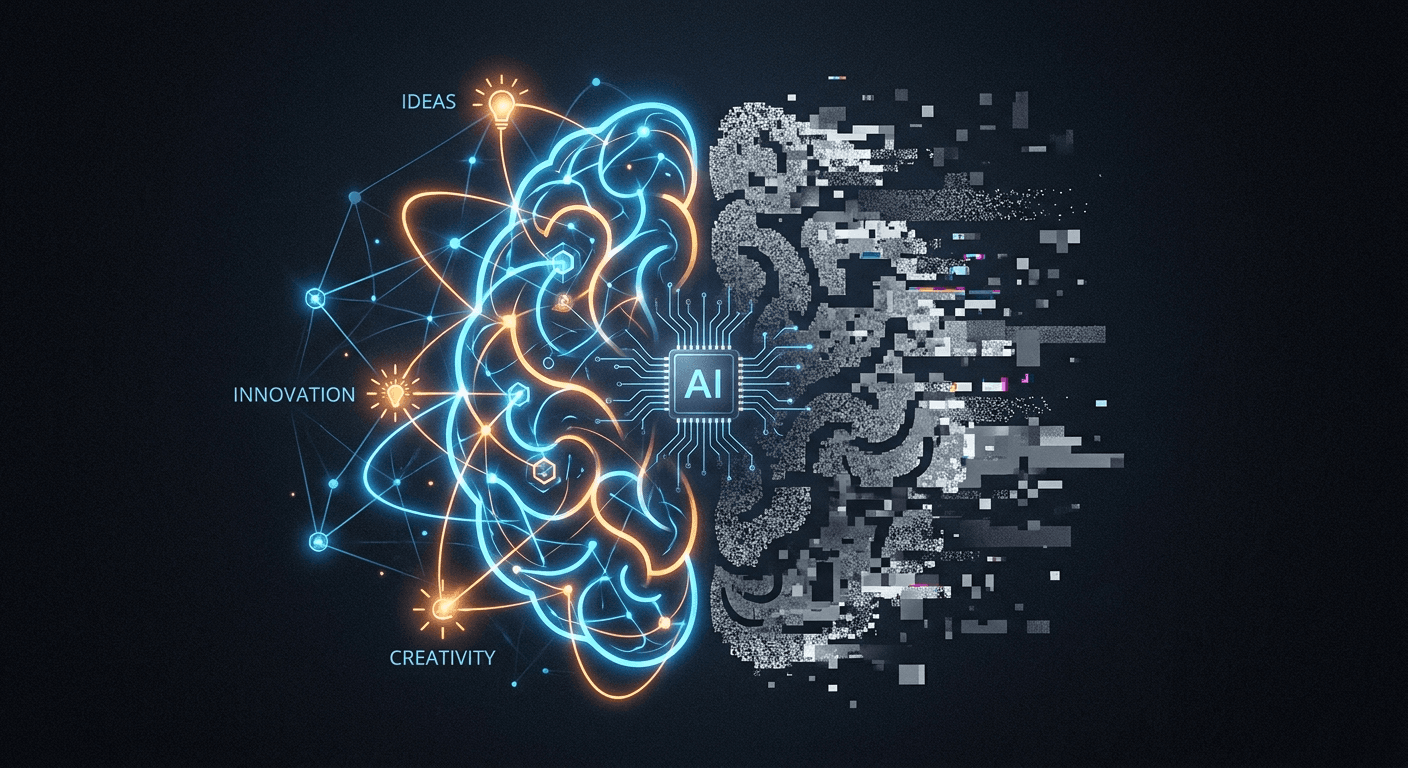
A post hit the top of Hacker News this week with a title that stopped me cold: "AI Should Elevate Your Thinking, Not Replace It." It drew nearly 500 upvotes and over 340 comments — not because it was controversial, but because it named something everyone feels but nobody wants to say out loud.
The author, Koshy John, has been talking to engineering managers across the tech industry and noticed something: people are splitting into two groups. Not AI users vs. non-users. Both groups use AI heavily. The split is in how they use it.
Group one uses AI to eliminate drudgery, move faster, and spend their reclaimed time on higher-level work — framing problems, making tradeoffs, spotting risks, and generating original insight.
Group two uses AI to avoid thinking entirely. They paste prompts, collect polished output, and present it as their own reasoning. For a while, it looks like productivity. It can even look like talent. But it's a dead end.
This distinction is the most important career fork of our generation. Let me tell you why.
The Illusion of Competence
Here's what makes this split so dangerous: AI-assisted non-thinking produces better-looking output than actual thinking.
A person who genuinely wrestles with a problem will produce something messy, nuanced, full of caveats and rough edges. A person who hands the same problem to Claude or GPT gets back something polished, well-structured, and confident — even when it's subtly wrong.
In meetings, the second person sounds better. In written reports, the second person looks better. In performance reviews, the second person appears more productive. The feedback loops of most organizations reward the appearance of competence, not competence itself.
This creates a ticking time bomb. Organizations are filling up with people who can produce but can't think. And nobody notices until something goes wrong that requires actual judgment — a crisis, an ambiguous decision, a novel problem that no model has been trained on.
Koshy John calls this "intellectual dependency being labeled as leverage." I'd go further: it's the professional equivalent of taking steroids. The short-term gains are real. The long-term damage is invisible until it isn't.
The Reps You're Skipping
Here's a simple truth about expertise: judgment comes from reps. Every time you work through a hard problem — really work through it, with the confusion and false starts and slow understanding — you're building pattern recognition that will serve you for decades. Every time you skip that process by accepting AI-generated output you don't fully understand, you're skipping a rep.
One skipped rep doesn't matter. A year of skipped reps creates a professional who looks senior on paper and thinks like a junior in practice.
I see this everywhere now. Writers who can "produce content" at incredible speed but can't construct an original argument. Developers who ship code they can't debug when it breaks in unexpected ways. Analysts who present insights they can't defend when someone asks a follow-up question.
The paradox is brutal: the more AI improves, the easier it becomes to skip reps, and the more valuable actual reps become. We're heading toward a world where genuine expertise is simultaneously rarer and more valuable than ever.
What the Best People Are Doing Differently
The people who are actually getting better in the AI era share a few habits that look deceptively simple:
They Use AI for the Boring Parts, Not the Hard Parts
The best engineers let AI draft boilerplate, generate test scaffolding, summarize documentation, and compress routine work. They don't let AI make architectural decisions, choose tradeoffs, or define the problem itself.
There's a useful heuristic here: if you could explain to a junior colleague exactly what you need and why, it's safe to delegate to AI. If you're hoping AI will figure out the "what" and "why" for you, you're outsourcing your job.
They Ask Sharper Questions
Most people use AI by dumping a problem and accepting the first response. The people getting real leverage use AI as a thinking partner — they challenge its assumptions, ask it to steelman the opposite position, request it to find holes in its own reasoning.
The quality of your AI output is directly proportional to the quality of your thinking before you prompt. This is the part nobody wants to hear because it means the work hasn't actually gotten easier. The nature of the work changed, but the difficulty didn't decrease — it just moved upstream.
They Verify Before They Trust
A colleague told me recently: "I use AI for everything, but I trust it for nothing." That might sound cynical, but it's the healthiest possible stance. They use AI-generated code as a starting point, then read every line. They use AI summaries as orientation, then read the source material. They use AI analysis as a hypothesis, then test it against data.
The extra step of verification isn't just about catching errors — it's about maintaining your own comprehension. When you verify, you're still doing the reps. When you copy-paste, you're not.
The Organizational Time Bomb
This isn't just an individual problem. It's an organizational one.
Companies that reward output volume over output quality are inadvertently selecting for the wrong group. When promotions go to whoever ships the most PRs, writes the most documents, or closes the most tickets, you're promoting the people who are best at generating volume — which is exactly what AI excels at.
The result: your leadership pipeline fills with people who are excellent at producing and terrible at deciding. When a real crisis hits — and it always does — you discover that nobody in the room actually understands the system they've been "building" for the past two years.
Smart organizations are starting to figure this out. Some are adding "explanation interviews" where engineers have to walk through their code and explain every decision. Others are creating "unplugged" problem-solving sessions where AI tools are deliberately unavailable. These aren't anti-technology measures. They're quality assurance for human judgment.
The Early-Career Trap
If you're early in your career, this split is even more consequential. You haven't built your pattern recognition yet. You haven't accumulated the reps that give you professional instinct. The temptation to shortcut with AI is strongest exactly when the cost of shortcutting is highest.
A senior engineer who uses AI to generate boilerplate has 15 years of context for evaluating what comes back. A junior engineer who does the same has none. The senior is accelerating. The junior is skipping the foundations.
This doesn't mean junior people shouldn't use AI. It means they should use it after they've attempted the problem themselves. Write the code first, then use AI to review it. Draft the analysis first, then use AI to challenge it. Form your opinion first, then use AI to stress-test it.
The order matters. AI after thinking is amplification. AI instead of thinking is atrophy.
A Practical Framework
If you want to stay on the right side of this split, here's a framework I've found useful:
The 70/30 Rule: Spend 70% of your working time on problems that are genuinely hard for you — where you're learning, struggling, and building new capability. Use AI to compress the other 30% — the routine, the repetitive, the tedious.
The Explanation Test: Before you use any AI-generated output, ask yourself: "Can I explain this to someone who will ask tough follow-up questions?" If yes, use it. If no, you don't understand it well enough, and using it is building on sand.
The Weekly Unplugged Hour: Once a week, work on a meaningful problem without any AI assistance. It will feel slow. It will feel frustrating. That feeling is your brain doing reps. Cherish it.
The Curiosity Check: When AI gives you an answer that surprises you, don't just accept it — investigate why it surprised you. That gap between your expectation and the AI's output is where learning lives.
The Fork in the Road
We're at a moment that will look obvious in hindsight. The tools are here, they're powerful, and they're only getting better. The question isn't whether to use them — that's settled. The question is whether you'll use them to become more capable or less capable.
Both paths look the same from the outside for about 18 months. After that, the gap becomes uncrossable.
The people who used AI to think harder, question deeper, and learn faster will be the most valuable professionals of the next decade. The people who used AI to avoid thinking will find themselves unable to do the work they've been claiming to do — and in a world full of AI, the only irreplaceable thing is genuine human judgment.