

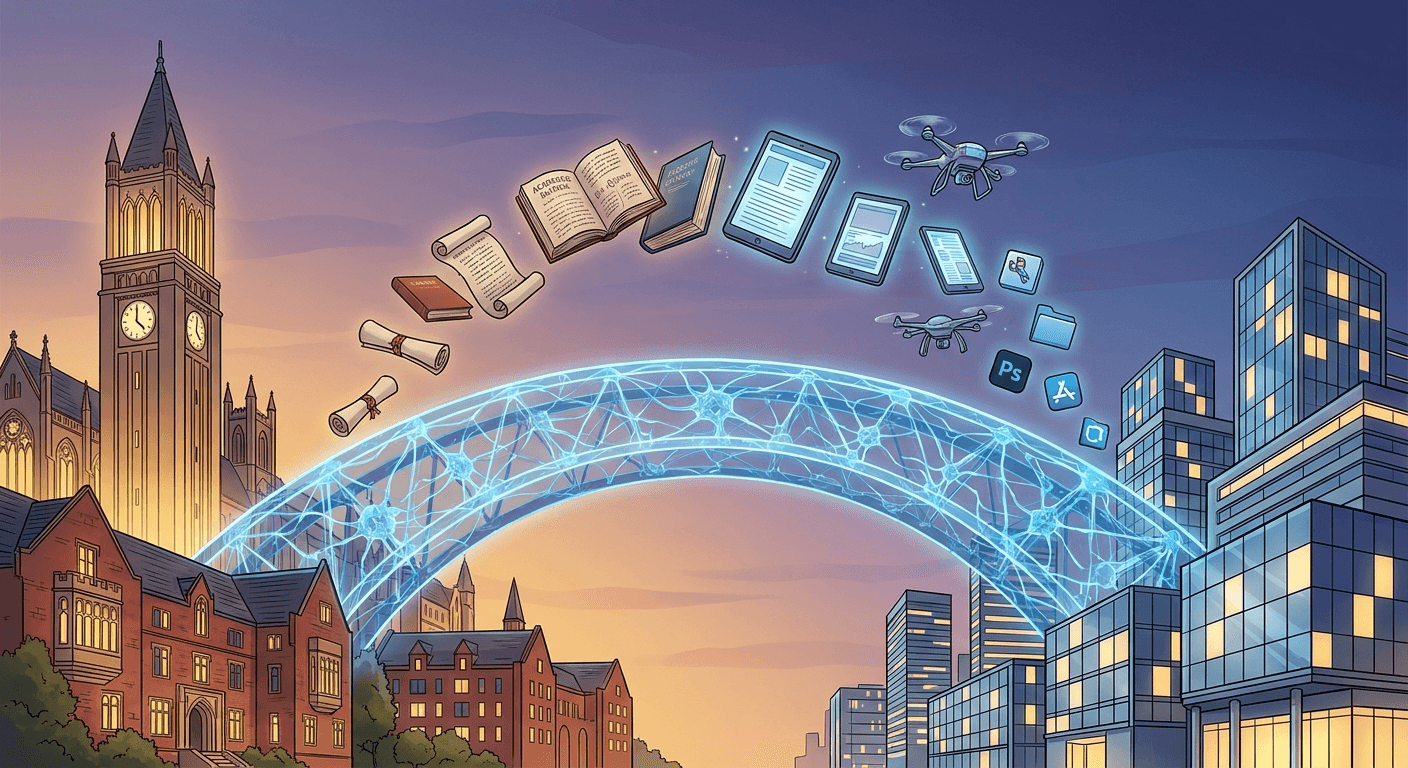
Something fundamental is shifting in how universities produce research, and if you're not paying attention, you're about to be caught off guard.
For decades, the pipeline from academic insight to real-world application followed a painfully slow trajectory: publish a paper, wait for someone in industry to notice it, hope for funding, iterate for years, maybe — maybe — see it become a product. The average time from academic breakthrough to commercial application was somewhere between 10 and 20 years. That number is collapsing.
AI isn't just a research topic anymore. It's becoming the research infrastructure itself. And the universities that understand this distinction are pulling ahead in ways that will reshape higher education for a generation.
The New Research Stack
This month, the Times Higher Education Asia Universities Summit 2026 dedicated its keynote to the "accelerating role of AI in higher education research and industry collaboration." That's not a fringe panel at a tech conference — that's a mainstream academic institution putting AI-driven research transformation front and center.
Meanwhile, Microsoft Research announced its 2026 fellowship cohort spanning AI, education, and systems. Penn State's College of Education launched a dedicated program supporting AI in graduate research. George Mason University's College of Education and Human Development is building frameworks for responsible AI integration. Howard University's Digital Lab is hosting AI equity workshops.
These aren't isolated initiatives. They're symptoms of a tectonic shift: universities are rebuilding their research infrastructure around AI, and they're doing it faster than anyone predicted.
The new research stack looks like this: AI-powered literature review that can synthesize thousands of papers in minutes. Automated experiment design that identifies promising hypotheses from existing datasets. Real-time collaboration platforms where AI agents help coordinate multi-institution research projects. And increasingly, AI systems that can generate and test code implementations of theoretical models before a human researcher even opens their IDE.
Why This Time Is Different
We've heard "technology will transform education" approximately ten thousand times. Usually, it doesn't. MOOCs were supposed to democratize higher education — they mostly served people who already had degrees. Learning management systems were supposed to personalize education — they mostly became PDF repositories. Smart classrooms were supposed to engage students — they mostly confused professors.
So why should we believe AI is different?
Because AI doesn't just change the delivery mechanism of education. It changes the production function of knowledge itself.
When a PhD student can use AI to conduct a literature review in an afternoon that would have taken three months, that's not an incremental improvement. That's a structural change in what's possible. When a research team can use AI to simulate experiments before running them in the physical lab, cutting their time-to-insight by 80%, that changes the economics of research entirely.
The Stanford HAI AI Index Report, which released its 2026 edition this month, tracks these shifts quantitatively. The data consistently shows that AI is not just improving research efficiency — it's enabling entirely new categories of research that weren't feasible before. Multi-modal analyses that combine text, images, and structured data. Cross-disciplinary research that connects insights across fields that never talked to each other. And real-time research responsiveness that can produce insights during unfolding events rather than years after the fact.
The Industry Bridge Is Finally Being Built
The most exciting part of this shift isn't what's happening inside universities. It's what's happening between universities and industry.
Microsoft's 2026 fellowship cohort is explicitly structured around AI, education, and systems — three domains that Microsoft cares about commercially. This isn't corporate philanthropy. It's strategic investment in research pipelines that will generate commercially valuable insights. And it's a model that's being replicated across the tech industry.
Google's DeepMind, OpenAI, and Anthropic all now have formal research partnerships with dozens of universities. These aren't the traditional "give us your smartest graduates" talent pipelines. They're genuine collaborative research programs where academic researchers get access to compute and models they could never afford independently, and companies get access to fundamental research that their product-focused teams don't have time to conduct.
The result is a new kind of researcher who speaks both languages: someone who understands the rigor of academic methodology and the urgency of commercial application. Penn State's new program supporting AI in graduate research is explicitly designed to produce these hybrid researchers — people who can publish a paper and ship a product in the same year.
The Equity Question We Can't Ignore
Not everyone is benefiting equally from this transformation, and pretending otherwise would be dishonest.
Howard University's AI Equity Workshop highlights a real concern: the AI tools that are accelerating research at well-funded institutions are often inaccessible to historically underserved universities. When a researcher at Stanford can access GPT-5 and unlimited compute through an industry partnership, while a researcher at a regional HBCU is still working with last-generation tools and limited cloud credits, the gap doesn't just persist — it accelerates.
This isn't a new problem. Research funding has always been unevenly distributed. But AI creates a multiplicative effect: the institutions with the best tools produce more research, attract more funding, which buys better tools, which produces more research. The flywheel spins faster at the top and stalls at the bottom.
Some initiatives are trying to address this. Microsoft's fellowship program intentionally includes researchers from diverse institutions. Federal funding agencies are beginning to earmark AI compute access for under-resourced universities. But the pace of these equity efforts is glacial compared to the pace of AI advancement.
If we're serious about AI democratizing research — and not just concentrating it further — we need to think about infrastructure access as a research equity issue, not just a technology issue.
What This Means for Builders and Founders
If you're building in the education or research space, here's what matters:
The research-to-product pipeline is a massive opportunity. Tools that help researchers move from insight to application faster — automated paper-to-prototype systems, research collaboration platforms, AI-powered grant writing assistants — have a hungry market of academics who are ready to adopt.
Open-source research tools will win. The equity gap means there's a massive underserved market of researchers at institutions that can't afford enterprise AI tools. Open-source alternatives that provide 80% of the capability at 0% of the cost will build enormous goodwill and distribution.
Cross-disciplinary AI platforms are underbuilt. Most AI research tools are domain-specific — built for bioinformatics, or NLP, or computer vision. Tools that help researchers combine insights across fields are rare and desperately needed. The best breakthroughs are increasingly happening at the intersections.
Compliance and ethics tooling is a growing need. As AI becomes more central to research methodology, universities need tools that ensure research integrity, track AI contributions, and maintain reproducibility standards. This is an emerging category that barely exists today.
The Bigger Picture
We're at an inflection point where the institutions that adapt their research infrastructure to AI will pull ahead dramatically, and those that don't will find themselves increasingly irrelevant. This isn't about whether AI belongs in the university. That debate is over. AI is already there — in the labs, in the libraries, in the lecture halls.
The real question is whether universities will shape how AI transforms research, or whether they'll let the transformation happen to them. The initiatives at Penn State, George Mason, Howard, and elsewhere suggest that at least some institutions are choosing to lead. Whether that leadership spreads broadly enough, quickly enough, to prevent the emergence of a two-tier research system remains the most important open question in higher education today.
The gap between lab and launch is closing. The only question is who gets to walk across the bridge.